Short answer
Can market stalls and street food traders get branded packaging in small quantities?
Traders do not need a full printed range to look established. The usual approach is one printed item that every customer holds — commonly the bowl, box or greaseproof pouch — combined with stock kraft packaging and low-cost extras such as printed stickers or branded napkins. Choose formats that hold heat and handle sauces in the open air, keep the design to one or two colours on kraft, and ask DORU for a quote covering realistic trader quantities.
One printed item can carry the whole stall
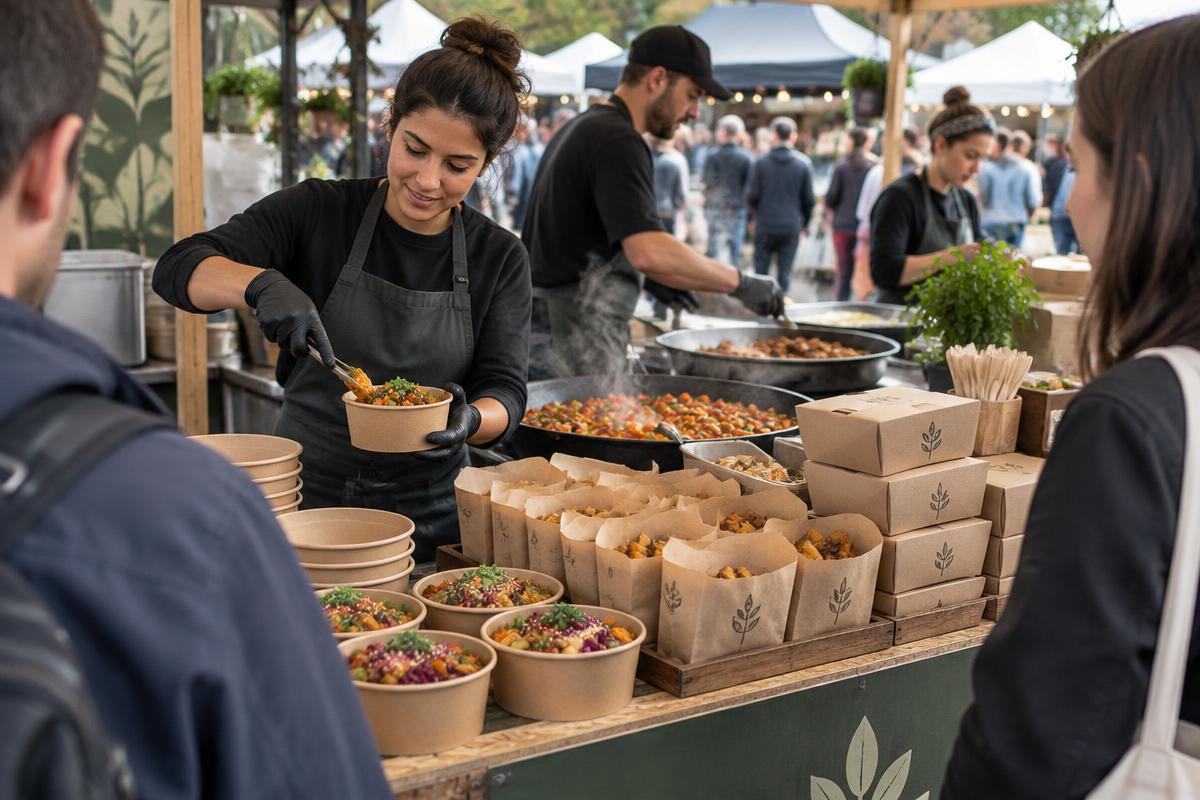
At a market, your packaging is your signage. The item held while queuing and eating does more brand work than anything else on the stall, so print that one first: usually the bowl for saucy dishes, the box for fried food, or the pouch for loaded fries and wraps.
Everything else can stay as plain kraft. A consistent natural material plus one confident printed item reads as a coherent brand, and it keeps the first spend small.
Outdoor service has its own demands
Street trading adds wind, cold air, queues and one-handed eating. Packs need a stable base that works without a table, a rim that holds a lid securely, and enough grease resistance for fried food served fast.
Vented formats help crisp food stay crisp when it sits for a few minutes under a heat lamp. Keep lids and bases matched exactly, and test the pack while walking with it rather than only on the counter.
- Round bowls for curries, rice boxes, noodles and salads.
- Clamshells and boxes for burgers, fried chicken and bakery items.
- Pouches and sheets for loaded fries, wraps and handheld food.
- Matching lids for anything a customer may carry away.
Design for kraft, not for a screen
Brown board absorbs ink, so fine detail, pale tints and photographic backgrounds lose definition. A bold logo, a simple pattern or a single strong colour will look sharper and cost less than full-coverage artwork.
Keep a clear area for price or allergen stickers, and check a proof at actual size. If your brand relies on an exact colour, say so early so the print team can advise what is achievable on natural material.
Keeping the first order affordable
Print becomes cheaper per unit with volume, so the aim is to find a quantity that is both economical and realistic for your trading pattern. Work from events per month and covers per event rather than an optimistic annual figure.
Options that help: print one item and keep the rest stock, choose one or two colours, use printed stickers on plain packs while volumes grow, or agree call-off stock so a larger print run is delivered in batches you can store.
Stay on the right side of the rules
Traders still need packaging that is suitable for food contact, and any recyclable or compostable wording has to match the material and local collections. Allergen information must be available for the food you sell, so leave space on the pack or plan for a label.
Ask your supplier for documentation on the exact products you print, particularly for claims such as PFAS-free, so you can answer questions from event organisers and customers with confidence.
Key takeaways
- Print the single item every customer holds and keep the rest plain kraft.
- Choose formats that cope with outdoor service, one-handed eating and grease.
- Design bold and simple: kraft flatters strong marks, not fine detail.
- Base quantities on events per month, and use stickers or call-off stock to stay affordable.
- Keep allergen information and material claims accurate for the products you print.
Author

Lan Olitoquit
Creative and Marketing Professional
Lan is a creative and marketing professional with over seven years of experience. He transforms brand messaging into compelling digital experiences, using data to craft high-converting campaigns. He is currently pursuing an MBA at San Beda College Alabang, bridging what business knows with what business does.
View all posts